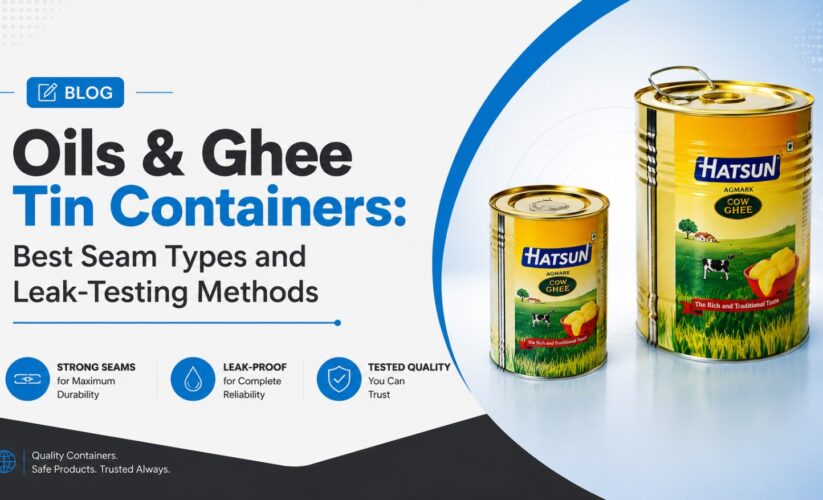
Oils & Ghee Tin Containers: Best Seam Types and Leak-Testing Methods
Spillage, rancidity, and brand damage often trace back to weak seams or poorly matched closures on oil and ghee tins. For edible fats, a tight, consistent seal is as critical as the artwork on the lid.
This guide distils seam type choices and practical leak-testing that procurement and packaging teams can specify with confidence. It is written for buyers shortlisting oil tin manufactures and ghee tin manufactures who need repeatable quality, export-ready documentation, and on-time delivery.
Ready to validate a spec? Request a sample kit and a seam test checklist to compare suppliers on equal footing.
Oil tin manufacturers and ghee tin manufacturers: seams, lids, and tests that prevent leaks
Why seam choice matters for oils and ghee
Edible oils and ghee flow more at high heat. Indian routes add vibration, stacking, and wide temperatures. A tight seam stops weeping, protects headspace, and keeps flavour true. The right seam, plus a good lid and food-safe coatings, cuts returns and keeps print clean in transit.
Shortlisting oil tin manufacturers or ghee tin manufacturers should start with seam capability and documented QA. Ask how they form, measure, and test seams on every batch.
Best seam types for oil and ghee tins
A 15 L oil tin that rides on highways needs a different build from a 500 g ghee gift tin on a semi-auto line. Pick the seam for your fill heat, planned stack height, and the closure you will use. Put the trade-off on the table: seamed vs. seamless.
Side seam: welded vs. soldered
Welded side seams remove solder, improve hygiene perception, and give steady strength up the wall. Soldered seams still exist on legacy lines but are rare today for food. Most Metal Tin Container Manufacturers for oils now favour welded side seams for predictable integrity and clean interiors.
End seams: double-seamed ends
Double seams join the body and ends by controlled curling and compression. For oils and ghee, set clear targets: body and cover hook lengths in the 1.2–1.6 mm range, overlap at 50–70%, and consistent tightness verified by seam teardown and micrometre checks. When you fit a spout with a plug lid or a lever lid with a pourer, match end panel curl, countersink, and fitments to the seamer tooling.
Seamless drawn bodies: when it helps
Deep-drawn, seamless bodies remove the vertical side seam. They cut leak paths on small to mid-size tins, which suits giftable ghee with snug plug lids. Tooling and press capacity drive feasibility and cost, so align early with Metal Tin Container Manufacturers if you want this route.
FeatureWelded Side SeamSoldered Side SeamDouble-Seamed EndsSeamless Drawn BodyLeak pathsLow, single vertical lineModerate, material variabilityVery low at ends when controlledNone on bodyAppearanceClean interior, neat exteriorVisible solder lineSeam ridge at endsSmooth wallsCost/toolingModern standardLegacy linesStandard on F&B tinsHigher tooling for drawingTypical useOils and ghee, paintsOlder installationsAll food endsPremium small ghee tins
Closures matter as much as seams. A plug lid with a food-grade gasket suits ghee. Lever lids or spouts with tamper tabs suit edible oils. A slip lid can work for dry SKUs in the same brand family, not for hot-filled fats. Match the closure to viscosity, pour needs, and retail format.
Leak-testing methods that hold up in Indian supply chains
Build tests that mirror your route and handling. A practical plan is: 25–30 kPa air test for 60 seconds per sample, hot–cold cycling from 5 °C to 45 °C, a 1 m flat-drop, and a 48–72 hour stack test at the planned pallet load. Record the method, limits, and rig calibration dates in the spec and check them during audits.
Air pressure and vacuum testing
Non-destructive air pressure or vacuum tests flag seam and gasket issues before filling. Use calibrated rigs, set pressure decay limits, and test a defined sample size per batch. For spouts and plug lids, combine with gasket compression checks to confirm proper seating.
Water-bath bubble testing
The classic water-bath method works well for sampling. Pressurise the tin slightly, submerge, and watch for bubbles from seams, curl areas, or fitments. It is quick for line changeovers and helps oil tin manufacturers catch setup drift.
Torque, gasket compression, and transport checks
Measure spout cap torque and plug-lid push-in force for repeatability. Typical ranges are 0.8–1.2 N·m for small spout caps and 20–35 N push-in for plug lids, set by your gasket and size. Run stack-and-drop sequences and include hot–cold conditioning where routes cross high-heat or monsoon zones.
Material, coatings, and gasket specs
Select a tinplate gauge that fits the size and pack duty. As a guide, 0.22–0.25 mm suits many 1–5 L oil tins, while 0.27–0.30 mm fits 10–15 L foodservice packs. Specify gauge/thickness tolerance, for example ±0.005 mm on sheet supply, so dent resistance and seaming stay consistent.
Use internal food-safe coatings that suit fats, and verify against your fill heat to limit flavour scalping and staining. For gaskets, pick compounds formulated for edible oils and ghee, then qualify them under your storage climate. Metal gives an excellent moisture and odour barrier through the body and blocks light completely; the seam and gasket are the usual leakage paths.
If you run more than one SKU size, keep a common tinplate gauge family where it makes sense. It simplifies buying and reduces variability.
Decoration and brand control
Tins are highly visible on shelf. Lithographic printing supports colour-accurate graphics across large runs. Build colour management into briefs and ask for drawdowns or swatches. Set measurable targets, such as ΔE ≤ 2–3 across reprints, and request spectro readings on control strips.
For premium ghee packaging containers, consider Embossing/Debossing on lids or panels to add tactile branding without affecting seam integrity. Explore adjacent F&B formats on our Premium Tin Containers page for cross-SKU finish alignment. For liquids in retail, see our Beverages Tin Containers range to benchmark pourer fitments.
Compliance, SHE, and QA controls
Request batch-wise quality control data, including seam micrometry, overlap calculations, and leak-test results. Food-contact safety relies on approved coatings and clean handling during fabrication and packing. A supplier culture that calls out SHE (Safety, Health, Environment) and CSR (Corporate Social Responsibility) often shows tighter process discipline, which you can see as consistent seams and clean interiors over time.
Nikita Containers validates seams with in-process checks and final inspection on category-specific tins, then maintains lot traceability for audit requests.
Ordering and logistics: MOQs, lead times, exports
State the MOQ (Minimum Order Quantity) you can support and ask for tiered quotes. As a practical range, common 1 L welded tins run at 10,000–25,000 units per print design, while new tooling or special colours can lift that to 25,000–50,000. Deep-drawn seamless bodies often start higher due to press setup time.
Plan lead time by pack type. Plain bodies can ship in 3–5 weeks in many cases, and printed runs may need 6–8 weeks, depending on plate making and print slots. If your sales spike around Diwali or summer, block press and print slots 6–8 weeks ahead and share a rolling 12-week forecast so tinplate and gaskets land on time.
Artwork dielines speed approvals. Ask for dielines at RFQ, along with sample tins for line trials. For export shipments, confirm pallets, cartons, and export documentation formats well in advance.
Applications and format recommendations
Oil and ghee packs range from retail to foodservice. For large volumes, specify welded side seams with double-seamed ends and a lever lid or spout for controlled pouring. For premium gifting lines, tin containers for ghee with seamless bodies and plug lids project quality and reduce leak risk.
If you also handle dry assortments alongside fats, align finishes and inks across categories such as Dry Fruits Tin Containers or Chocolates Tin Containers to maintain brand consistency.
As Metal Food Packaging Containers, tins block light completely and offer a strong moisture and odour barrier when seams and gaskets are set up well. They sit within recyclable metal packaging streams, which helps recovery at end of life.
When you shortlist Metal Tin Container Manufacturers, ask them to hold colour targets across reorders and to share SPC on seam metrics. That level of control shortens line trials and keeps OTIF stable for oil and ghee tin containers.
Frequently asked questions
Which seam type is best for edible oil tins?
For most edible oil formats, a welded side seam with double-seamed ends offers dependable integrity and clean interiors. Pair this with a compatible spout or lever lid and validate with routine pressure and water-bath tests.
Are seamless tins necessary for ghee?
Not always. Seamless drawn bodies help on small premium ghee SKUs by removing a vertical leak path. For larger packs, welded side seams with correct plug-lid gaskets and verified double seams work well.
What coatings should I specify for ghee packaging?
Choose food-safe coatings suited to fats and dairy-derived products, then test against your fill temperature and storage profile. Ask for compatibility data and retain samples from pilot runs for review.
How do I reduce colour variance across reorders?
Insist on lithographic printing with formal colour management and approved drawdowns. Keep inks, finishes, and substrate gauge consistent, and reference previous lot numbers when you issue POs.
What MOQs apply for customised oil and ghee tins?
MOQs vary with size, tooling, and decoration complexity. Discuss your SKU plan early, request dielines, and run a pilot batch to refine specifications before committing to full-scale production.
Which closures suit oils vs. ghee?
Spouts or lever lids suit oils for controlled pouring and tamper visibility. Plug lids with food-grade gaskets suit ghee, providing a snug, reclosable seal for repeat use.
Choosing the right seam and validating it with practical leak tests will stabilise your edible oil and ghee packaging. Specify welded or seamless bodies as needed, verify double seams, and align coatings, gaskets, and colour controls for a clean, repeatable supply. When you need scalable production with documented QA, work with a partner that treats seam integrity as a measurable specification, not an assumption.
Request a quote with your MOQ and target lead time, or ask for dielines and samples to begin trials on your filling line.